Heat your home with power the grid can't use yet.
Heat21 combines compute heat recovery with hot-water thermal storage for UK homes. The Node turns electricity into useful heat, while compute earnings can offset running costs.
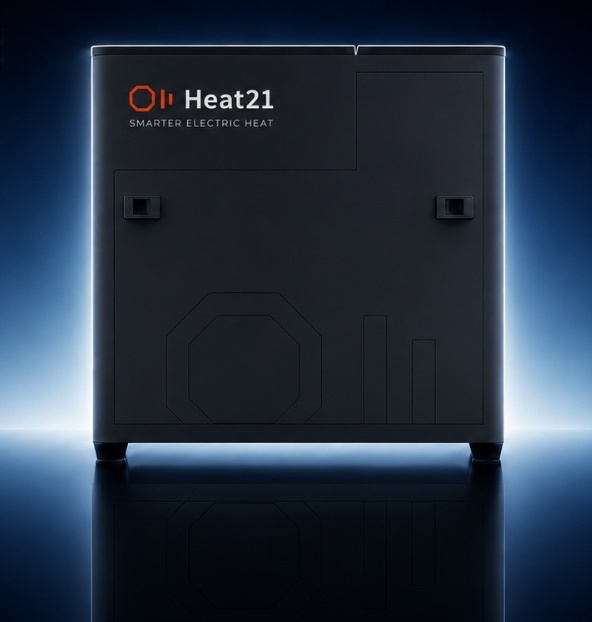
The Heat21 Node
From surplus power to warm water
Scotland pays wind farms to switch off when the grid can't carry their power. Heat21 puts that surplus to work: SHA-256 compute runs on a building's existing supply and captures essentially all the heat it makes.
Power in
The Node runs on the building's existing electricity supply, drawing hardest when the grid has power it would otherwise pay to waste.
Heat captured
A hydronic cold-plate captures 96.2% of the heat the hardware produces and moves it into a water-tank heat battery.
Warmth on demand
The tank holds up to 90°C water, so even a flexing load delivers steady heating and hot water whenever the home calls for it.
Productive, flexible, harmless
Going electric is the obvious answer — but heat pumps won't fit many homes, and resistive heat is costly to run. Here, the hardware that heats the water also earns from computing, paying the cost down.
Productive
Every watt does useful work before it warms the tank. Compute earnings can offset electricity costs while the Node heats the tank. The contribution changes with market conditions.
Flexible
The heat battery decouples heating from load, so the Node can flex with the grid. Aggregated, the fleet behaves as a Virtual Power Plant.
Harmless
When it stops, it simply stops. No combustion, no emissions on site, no waste heat vented to nowhere.
For the home
Product performance
96.2%
heat captured
up to 90°C
water output
For the grid
Why flexible demand matters
8.3 TWh
wind curtailed, 2024
£393m
paid to switch off
From 30p to about 11p per kWh
Nothing changes at your meter — you pay your own supplier, on your own tariff. Two things pull the effective price down: the Node earns from its computing while it heats, and the water tank lets it buy electricity only in the cheap half-hours.
Fixed tariff today
With the Node
Node + smart tariff
Worked example — Southern Scotland (Region N), 7.4kW Node. Offset ≈5.3p per kWh consumed uses the entered difficulty, BTC/GBP and hardware efficiency, a rolling 144-block average value of 3.146 BTC (3.125 BTC subsidy plus transaction fees), and a 2% pool fee. Today's levels use market data checked every 24 hours. Smart rate: 12 months of Octopus Agile prices with 07:00-10:00 and 16:00-19:00 avoided (16.6p/kWh average). Illustrative; excludes hardware purchase, maintenance, downtime and tax. Figures are per kWh of electricity consumed, not per kWh of useful heat delivered. Read the heating-cost assumptions.
Our related GWhFI project shows measured immersion-heater electricity use alongside Agile prices. It demonstrates tariff-responsive water heating; the dashboard does not measure the Node's compute revenue or useful heat delivered. How to read the demonstration.
Warmth where a heat pump can't go
Homes now
Lower-cost heat and hot water for properties where a heat pump won't fit, won't perform or won't pay, including homes moving away from biomass, oil or gas.
Hotels, multi-flat & district heating next
Constant hot-water demand makes shared buildings a natural fit for the same system, scaled to bigger tanks and higher daily use.
Farms, estates, greenhouses & light industry next
Useful heat for rural and commercial sites with space, power and demand, from plant rooms and workshops to growing heat and process heat.
A practical guide to compute-powered heating
Explore the heat-first approach, the technology, the space a thermal store needs, and the assumptions behind the running costs.
Heat as a service: heat comes first
Why we make useful heat the main product and use compute as a co-product that can help pay for it.
Read the Heat21 approach →How compute heat recovery works
From specialised computing hardware to useful hot water: what the Node does and where it fits.
Explore heat recovery →Electric heating with thermal storage
How storing heat shifts electricity use, and what to consider for your home.
Understand thermal storage →Understanding heating costs
Tariffs, compute earnings and heat losses: compare assumptions with the live calculator.
Check the cost model →Smarter heat. For your building.
The first installs are underway. Tell us about a building and we'll get back to you directly — or follow every step in our Telegram community.